Posts

Showing posts with the label spirituality

Scripture, Stones, Spirituality and human encounter: the MES study-pilgrimage to the Holy Land

Image
The MES (Ministry Experience Scheme) is a programme largely funded by the National Church which places young persons, 18-30, who may be exploring ordination into parochial settings to get a sense of life in parish ministry. The MES programme of this diocese is one of the most successful across the Church of England. It is headed by Dr Clare Amos, our Director of Discipleship, with support from Fr William Gulliford our Director of Ordinands. Dr Amos at the Dome of the Rock One part of our diocesan MES programme which has not been able to be realised for the past two and a half years due to COVID has been a study-pilgrimage to the Holy Land. Finally this year we were able to restore this trip and so 10 interns spent from 7 to 15 July, visiting the Biblical lands, accompanied by Dr Amos, Fr Gulliford, the Revd Carolyn Cooke from the chaplaincy of La Côte, and myself. We were further very pleased that an intern from a similar programme of the Episcopal Church (TEC) in Europe, who is servin...

Introduction to Spiritual Direction: a new programme in the Diocese

Image
From 21-23 November, the Director of Training, Canon Ulla Monberg, hosted an Introductory Weekend to Spiritual Direction, which will be the start of an ongoing programme within the Diocese. 9 persons who are presently engaged in spiritual direction or who are interested in developing this ministry attended the weekend which was held at St Cuthman's Retreat Centre in Sussex. The Revd Dr Mark Godson, Director of the London Centre of Spirituality, was the joint facilitator for this course, along with Canon Monberg. The programme is in response to a desire for training in spiritual direction which emerges as a frequent theme in ministry reviews with our diocesan clergy and readers.

Lent is the road to a new beginning

Image
Today we enter the journey of Lent to prepare ourselves for the great Easter feast. Most of us lead lives that are far too busy. In these forty days we are invited to follow Jesus into the wilderness, a place away from distractions and frenetic activity, to reflect on our lives. The disciplines of prayer, fasting and self-denial, and reading and meditating on God's Holy Word, are aids to help us to refocus our lives and orient them once again towards God. O Lord our God, when death had entered this world through sin, Jesus your Son, led by the Spirit into the wilderness of temptation, chose to worship and serve you alone. Lead us through these forty days of Lent to the font of living water where we find new birth, pardon and life in your word and living bread.

Midi-Pyrénées and Aude Parish spend a day looking at prayer and spirituality together

Image
Over 20 persons from the Parish of Midi-Pyrénées and Aude gathered on Saturday 15 September in Toulouse for a day to reflect on aspects of prayer and spirituality. There were two major presentations, one on the purpose of prayer and the other about various ways of prayer and spirituality known to Anglicans in Europe. It was a rich occasion, with many deep questions being shared about what is at the heart of our faith - our relationship to God, and our journey with our Lord Jesus. Midi-Pyrénées and Aude is a parish that covers territory twice the size of Wales, with 7 congregations served by the Revd Canon Andrew Hawken, and his assistant priests, the Revd June Hutchinson, and the Revd Canon Tony Jewiss, along with several licensed readers and retired assistant clergy. The website is here .

The Blessed Virgin Mary

Image
15 August is the feast of the Blessed Virgin Mary. Christians have celebrated this day since at least the 5th Century. It is known by several titles. Eastern Christians refer to  The  Dormition of Our Lady. The Anglican Church of Canada calls it  T he  Falling Asleep of the Blessed Virgin Mary . For Roman Catholics and others, the feast is known as The  Assumption of the Blessed Virgin Mary . The Church of England title is simple:  The Blessed Virgin Mary and   was chosen to avoid doctrinal controversy! 50 years ago when the Second Vatican Council of the Roman Catholic Church was convened, one of the hot topics debated was whether to produce a document on Mary. In the end it was decided to say something about Mary, not in a separate statement, but as part of the fuller ecclesiological document, the Dogmatic Constitution on the Church (known by its the Latin title Lumen Gentium). A vital truth is contained in this decision: Mary's place is among ...

Archbishop of Canterbury Joins the Millennium Celebration of the Camaldoli Community

Image
On Sunday 11 March, I accompanied the Archbishop of Canterbury to the Church of San Gregorio al Celio in Rome, which is now a monastery of the Camaldoli. The Camaldoli are a community of monks and nuns, founded by St Romuald, himself a Benedictine monk. They follow the Rule of St Benedict, but combine the ancient dimensions of solitary as well as community life: hermitage and monastery. This year is the 1000th anniversary of their founding.   The Archbishop was hosted at a festive lunch with the community and after gave a lecture on "Monastic Virtues and Ecumenical Hopes". He spoke of the ecumenical significance of monastic communities which are gathered around the Word of God, that  "the monastic ideal is something that stands in opposition to anything that looks like a "tribal" Church. It tells us that the hope of a truly universal reconciliation is only to be found in a Church that is able to look beyond natural affinity and to sustain bonds that are i...

Ash Wednesday: the 40 day journey begins

Image
....for in these forty days you lead us into the desert of repentance that through a pilgrimage of prayer and discipline we may grow in grace and learn to be your people once again. (Proper Preface for Lent,  Common Worship).  Christians journey in Lent towards the Cross and Resurrection. We recall the forty year pilgrimage of the ancient people of Israel, between slavery in Egypt and the security of the promised land. It was a prolonged time in the wilderness, the desert, with little water, food or resources. But in the poverty of that sojourn the people learned of God's covenant with them, revealed at Mt Sinai. So may our Lenten discipline renew our faith in the promise of salvation. Lord, free us from falling into the sin of believing that the slavery in Egypt is better than the struggles in the desert. (A prayer from Nicaragua)     

Fat Tuesday is here; you know what comes next...

Image
Today is Shrove Tuesday, or Mardi Gras. The former name recalls this as a time to be shriven or for confessions to be heard, and penances imposed. The latter name, “fat Tuesday”, points to the need to use up the rich ingredients in the kitchen before the Lenten fast, hence the tradition of eating pancakes.  Lent begins tomorrow, Ash Wednesday.  The Book of Common Prayer makes clear that the 40 days of Lent are days of “fasting or abstinence”. The 40 days do not include Sundays, which are always feast days. As a season to “tune up” our spiritual lives, there are many ways to observe this solemn period. Some suggestions include, Carving  out time for daily prayer, perhaps using one of the forms for the daily office of the Church, such as  Common Worship: Daily Prayer.  ( This is available online here , by the way). Switching off or reducing one’s wired connections, disciplining the use of the internet, facebook, emails etc, using the gained time ...

Pentecost and the Church's mission

Image
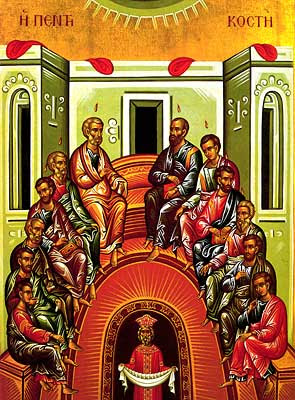
The traditional icon of Pentecost has some features that are easily identified by Western Christians: the gathered Apostles, and the tongues of fire upon them, sign of the Holy Spirit, given to the Church on this day. But there is a mysterious figure, like a king, around whom they appear to be gathered. Who is he? The Eastern Churches teach that he is a symbol of the cosmos. Thus he is surrounded by darkness, as the world lives in the darkness of sin. But the figure is holding scrolls which represent the teaching of the Apostles, which through the Church's witness, is carried throughout the nations of the earth. The icon links this great feast to the mission of the Church: a mission which is driven by the power of the Holy Spirit, and which is at the heart of the Church's life, as we can see the Apostles gathered around it.  Blessed are you, O Christ our God, who made fisherman all-wise, by sending down upon them the Holy Spirit, and through them, drawing all the world into...

Pentecost 2011: A message from the Presidents of the World Council of Churches

Image
The 8 Presidents of the WCC, the fellowship of 349 Orthodox, Anglican, Old Catholic and Protestant Churches, has issued their Pentecost message to the world's Christians. Dr Mary Tanner, a lay theologian of the Church of England is one of the Presidents.   You shall receive power when the Holy Spirit has come upon you.  (Acts 1:8) The promise of the resurrected Christ before his ascension was actualized on the day of Pentecost in two types of power: the sound “as of a rushing mighty wind” and “tongues as of fire” (Acts 2:2-3). The advent of the Holy Spirit surpasses all possible description. For this reason Luke the evangelist uses the word “as”. The powerful wind completely renews the entire atmosphere; it creates a new climate, providing a life-giving environment of breath and energy.  “This energy filled the whole house where they were sitting.”  The disciples were flooded, immersed, “baptized” in this divine energy, as the Lord had previously announc...

Easter Greetings

Image
The Easter icon traditionally depicts the descent of Christ into hell after the crucifixion. Our Lord stands on the Cross, portraying his own victory. He takes Adam by the hand and raises him to life; Eve awaits resurrection with her hands outstretched. Christ is surrounded by figures of the prophets, Old Testament kings, John the Baptist, the Apostles. But what I find interesting is the young person to Christ's left, with a shepherd's staff. It is Abel, the first victim of violence, killed by his brother Cain.  So much more than an empty tomb: Easter is about Christ our Victorious God who reaches into the depths of human hell to bring new life, new hope and a reign of peace. You rose from the tomb as God in glory, and raised the world up with you. Mortal nature sang your praise as God, and death disappeared. Adam dances, Master, and Eve, now freed from her chains, rejoices as she cries: It is you, O Christ, who grant Resurrection to all. ( Orthodox Kontakion for t...

Lent - a time to strengthen our passion to serve

Image
Lent is upon us again. Christians live these 40 days of prayer, fasting and self-denial as a way of strengthening our resolve to turn from all that separates us from God and return to his generous heart. But the 40 days also remind us of the 40 years that the people of Israel spent wandering in Sinai when they grew to understand God’s special vocation for them in the world. It is also reminiscent of the 40 days that Christ spent in the desert, a place thought to be where demons lived and God was absent. Our Lenten discipline gives us a chance to reconnect with God's call to us to be his people, and to be in solidarity with all who hunger for food, peace and justice and with all who struggle against evil and yearn to know God's presence. Lord of justice and kindness, keep us strong through Lent. Unite us to our neighbours in need, and strengthen our desire to make this world a better place. Amen.

A ancient Christmas question: Who is Christ?

Image
Christmas is not the most ancient of Christian feasts. There is little evidence of 25 December as a day to celebrate Christ’s birth before the mid 4th century. According to the Revd Dr Paul Bradshaw, an eminent liturgical scholar (and the Liturgical Advisor of this diocese in Europe) the earliest reference to 25 December as the Feast of the Nativity appeared around 354 in Rome. (However in other parts of the Church such as in Egypt, 6 January was observed from the late 2nd century as both the commemoration of the birth of Jesus as well as his baptism. The latter continues to be a theme of the 6 January feast of the Epiphany). Why the slow start to dedicate a feast to the birth of Jesus? The hesitancy might stem from the Church’s theological debate with the Arians about the relationship of God the Father and his Son Jesus Christ. “Were they equal or not?” was the question. The Arians would be in favour of marking the Son’s beginning or birth in time as they were unsure about the equa...

Wait and prepare

Image
Advent puts the brakes on when much of the world wants to plunge right into full blown celebration of Christmas. Christians are invited to wait and prepare for the Lord who comes. A spirituality of waiting and preparation follows the biblical pattern set by the great Advent saints, St Mary the Virgin, waiting for the birth of her Son and St John the Baptist, preparing the way of the Lord. Both Advent saints are seen above either side of our Lord in this Cretan apse painting. The poor of the world have no choice but to wait, for food, for shelter, for justice. Our Bishop's Advent Appeal is a way for us to be in solidarity with those who wait patiently, in this case the community of Sudanese refugees in Finland, waiting and preparing for the day when peace returns to their land, and young school children in Martissant outside Port-au-Prince Haiti, waiting for their school to be rebuilt, so they can prepare themselves to face the future with some hope. God our roc...

Mary: Grace and Hope in Christ

Image
15 August is the Feast of the Blessed Virgin Mary. The rules of the Church of England permit this festival to be celebrated on the Sunday when it falls on that day, rather than be transferred to a nearby weekday, as would happen to a lesser commemoration. This feast is also known as the Assumption of the Blessed Virgin Mary (the official Roman Catholic title), the Dormition of the Holy Theotokos (an Orthodox designation). The Book of Common Prayer of the Anglican Church of Canada prefers the Falling Asleep of the Blessed Virgin Mary . These titles relate to the end of the Virgin's earthly life when her being taken to God is understood to be a sign of the eschatological hope of all humanity. So, in the words of one of our Church of England prayers for this feast, It is indeed right and good, our duty and our salvation, almighty Father, ever-living God, to give you thanks and praise for the work of your grace in the Blessed Virgin Mary ... In her you show us the greatness ...

Olive or Palm branches?

Image
The Sunday before Easter is known as Palm Sunday. The Church celebrates the Lord's messianic entrance to Jerusalem where he enters the mystery of his death and resurrection. It begins the week called Holy Week. The liturgical colour changes from violet to red to mark the commemoration of our Lord’s passion. St George's College, the Anglican study centre in Jerusalem, in one of their circular letters pointed out that to understand Palm Sunday one must understand the distinction made in the Scriptures between the olive branch and the palm branch. (Only in St John's Gospel are the branches named to be palm branches , the other three Evangelists speak only of branches ). Marcus Borg and Dominic Crossan in their 2006 book The Last Week  suggest that there would be two processions on their way to Jerusalem during the Passover. The "imperial procession" would come from the west, perhaps from Caesarea Maritima, with the emperor's representative, Pilate, coming to...

The Presentation of Christ in the Temple

Image
The Feast of the Presentation of Christ in the Temple (2nd February) celebrates the events in the Gospel of St Luke when Mary and Joseph took the baby Jesus to the Temple in Jerusalem, 40 days after his birth, to fulfill the requirements of the law of Moses. It is one of the most ancient feasts of the Church. Egeria, a Spanish nun on pilgrimage to Jerusalem around 381, describes the feast in her remarkable journal: "On that day there is a procession into the Anastasis [the site of the Resurrection], and all assemble there for the liturgy; and everything is performed in the prescribed manner with the greatest solemnity, just as on Easter Sunday. All the priests give sermons, and the bishop, too; and all preach on the Gospel text describing how on the fortieth day Joseph and Mary took the Lord to the temple, and how Simeon and Anna the prophetess, the daughter of Phanuel, saw Him, and what words they spoke on seeing the Lord, and of the offering which his parents brought. Aft...

Letter from Taizé

Image
On the 28 December, Brother Alois, the Prior of the Taizé Community sent me a copy of “ A Letter from China ”. He had just completed a three-week visit to China with two other brothers, one Chinese and another Korean. They were greatly influenced by the testimonies they saw and heard. A Letter from China contains a deeply spiritual message encouraging us to pay attention to what is already found in the depths of our own being, as a way of listening to God. It makes the point that being filled with a thirst for God should not detach us from the concerns of the world around us. “On the contrary, this thirst leads us to do all we can so that others may enjoy the benefits of creation and find joy in living”. In the letter there is also a very simple instruction about putting together an ecumenical prayer service in the style of Taizé. This is a useful resource for our congregations, some of which already have regularTaizé services (such as in the Parish of Nerja and Almuñécar). Othe...

Happy Epiphany

Image
The traditional icon of the Epiphany is that of the baptism of Jesus because one of the most ancient dimensions of this feast is the baptism of Our Lord, which now in the Western Church is celebrated on the Sunday following the Epiphany. In that event, in a mystical and unique way, the Holy Trinity itself is made manifest: the Father speaks a word "this is my Son, the beloved", the Spirit descends like a dove, and of course the presence of Christ the Son, identifying completely with humanity, as he, the sinless one accepts the baptism for repentance. Epiphany is a feast of light even though it is the day when in the West, the Christmas lights traditionally come down. One of the treasures of Western Christianity is the Ambrosian rite, still used in the Archdiocese of Milan. I find it much more poetic than the starker Roman rite which is the basis of Anglican liturgy. This introit from the eucharist of the day, and this prayer from evensong, help capture the motif of light f...